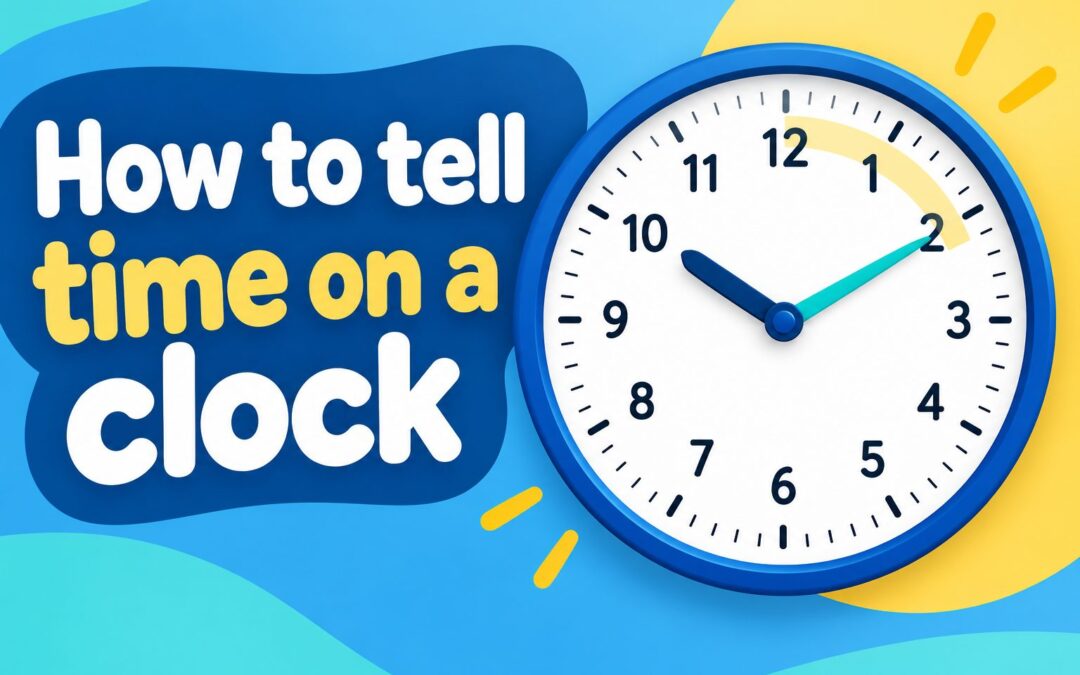
Learning how to tell time on a clock is an important everyday skill. It helps children follow routines, arrive on time, understand schedules, and communicate clearly with others. Although digital devices display time instantly, reading an analog clock teaches valuable ideas about numbers, counting, fractions, movement, and elapsed time. The key is to recognize what each hand means, understand the numbers around the clock, and read the hour before the minutes. This guide explains how to tell time on a clock step by step, including quarter hours, half hours, exact minutes, morning and evening times, common mistakes, practical examples, and useful practice methods. Whether you are teaching a child, refreshing your own knowledge, or learning to read an unfamiliar clock face, the process becomes much easier when you use a consistent order and practice with real-life situations.
How A Clock Shows Time
An analog clock uses a round face, numbers, and hands to show the current time. Each part has a specific job, so reading the clock becomes easier when you examine the parts in the same order every time.
1. The Clock Face
The clock face is the circular surface containing the numbers one through twelve. These numbers are arranged clockwise, beginning with twelve at the top. The face represents a complete cycle of twelve hours, and the same positions are used during both the morning and evening.
2. The Hour Hand
The short hand is usually the hour hand. It points toward the current hour, although it may sit between two numbers as time passes. When the hour hand is between four and five, the time is still in the four o’clock hour until the minute hand completes the hour.
3. The Minute Hand
The long hand is usually the minute hand. It shows how many minutes have passed since the beginning of the current hour. Because the clock has twelve numbered positions and sixty minutes in an hour, each number represents five minutes when counting with the minute hand.
4. The Second Hand
Some clocks include a thin second hand that moves more quickly than the other hands. It counts individual seconds, but you usually do not need it to tell the hour and minutes. Focus first on the hour and minute hands when learning the basic skill.
5. Clockwise Movement
Clock hands move clockwise, traveling from twelve to one, two, three, and around the face back to twelve. Knowing this direction helps you follow the order of the numbers and understand that the hands move forward through time rather than randomly.
6. The Twelve-Hour Cycle
An analog clock repeats the numbers from one to twelve twice each day. The clock alone cannot always show whether it is morning or evening. You need context, a schedule, or an indication such as a digital display to identify the full twenty-four-hour time.
How To Read The Hour Hand
Reading the hour hand correctly is the first major step. Always identify the hour before counting the minutes, because the position of the hour hand changes gradually rather than jumping instantly from one number to the next.
1. Find The Short Hand
Begin by locating the shorter, thicker, or slower-moving hand. This is normally the hour hand. Clock designs vary, so length is more reliable than color or shape. If the hands look similar, watch them move or compare their positions with a known time.
2. Look At Its Nearest Number
Check which number the hour hand has most recently passed. If it has moved beyond the seven but has not reached eight, the hour is seven. This rule prevents the common mistake of choosing the number that the hand is approaching.
3. Check Whether It Is Exact
When the minute hand points directly at twelve, the hour hand should point directly at an hour number. For example, a short hand at six and a long hand at twelve means six o’clock. Exact-hour times are the easiest starting point for practice.
4. Notice Movement Between Numbers
As minutes pass, the hour hand gradually travels between numbers. At half past two, it should be halfway between two and three. This movement confirms that the hour hand does not remain fixed in one place for the entire hour.
5. Use The Previous Hour
When the hour hand sits between two numbers, name the earlier number. If it lies between nine and ten, the time is in the nine o’clock hour. The minute hand determines how far into that hour you are, but it does not change the hour until twelve is reached.
6. Confirm With The Minute Hand
After selecting the hour, use the minute hand to confirm your decision. A minute hand near twelve means the hour is beginning, while a minute hand near eleven means the hour is almost finished. The two hands should always be read together.
How To Count Minutes On A Clock
Once you know the hour, count the minutes using the long hand. The fastest method is to count by fives from twelve, then add individual minute marks when the hand falls between the numbered positions.
1. Start At Twelve
The twelve position represents zero minutes when the minute hand is exactly at the top. It also marks sixty minutes when the hand returns there. Saying “zero minutes past” is usually unnecessary, so a time such as 8:00 is simply eight o’clock.
2. Count By Fives
Each numbered position equals five minutes: one is five, two is ten, three is fifteen, and so on. Continue around the clock until eleven equals fifty-five. Memorizing this pattern makes reading most analog clocks quick and accurate.
3. Add Individual Minute Marks
There are usually four small marks between each pair of numbers. After counting the nearest group of five, count the extra marks. For example, one mark after the number four means twenty-one minutes, while three marks after four means twenty-three minutes.
4. Read Past The Hour
When the minute hand is between twelve and six, say the hour followed by the minutes past that hour. A minute hand on five means twenty-five minutes past. If the hour hand is between seven and eight, the time is 7:25.
5. Read Before The Hour
When the minute hand is between six and twelve, you can describe the time as minutes before the next hour. For example, 7:50 is ten minutes before eight. You can also say seven fifty, which is often clearer and more commonly used.
6. Check The Minute Hand Position
Before answering, make sure the minute hand is not being confused with the hour hand. The minute hand usually travels around the face more quickly and points farther from the center. Comparing hand length, thickness, and movement helps resolve uncertainty.
Common Time Expressions On A Clock
People use several expressions to describe the same time. Learning these phrases helps you understand conversations, classroom instructions, appointments, and schedules more naturally.
- O’clock: Use this when the minute hand points to twelve, such as three o’clock or eleven o’clock.
- Half Past: Use this for thirty minutes after an hour, such as half past four for 4:30.
- Quarter Past: Use this for fifteen minutes after an hour, such as quarter past six for 6:15.
- Quarter To: Use this for fifteen minutes before the next hour, such as quarter to nine for 8:45.
- Minutes Past: Use this for times shortly after the hour, such as twelve minutes past two for 2:12.
- Minutes To: Use this for times approaching the next hour, such as five minutes to ten for 9:55.
Steps For Telling Time On A Clock
Following the same sequence each time reduces mistakes. Use these steps when reading an unfamiliar analog clock, especially when the hands are close together or the design makes them difficult to distinguish.
- Find The Short Hand: Identify the hand that shows the hour, usually the shorter hand.
- Find The Long Hand: Identify the hand that shows minutes, usually the longer hand.
- Choose The Hour: Read the number the hour hand has passed most recently.
- Count The Minutes: Count by fives from twelve, then add individual marks.
- Combine The Readings: Say the hour first and the minutes second, such as 6:25.
- Check The Hour Hand: Make sure its position matches the number of minutes you counted.
- Consider The Context: Decide whether the time means morning, afternoon, evening, or night.
- Repeat If Needed: Look again calmly if the hands overlap or the clock face is decorative.
Examples Of Reading An Analog Clock
Examples make the relationship between the hands and the written time easier to see. Compare the hour hand and minute hand in each situation, then notice how the spoken expression can vary.
1. Exact Hour At Three
If the short hand points to three and the long hand points to twelve, the time is 3:00. You can say three o’clock. The minute hand shows that no minutes have passed, while the hour hand is exactly aligned with the three.
2. Fifteen Minutes Past Five
If the hour hand has just moved beyond five and the minute hand points to three, the time is 5:15. You can say five fifteen or quarter past five. The hour hand should be slightly past five rather than directly on it.
3. Half Past Eight
If the minute hand points to six and the hour hand is halfway between eight and nine, the time is 8:30. This is called half past eight. The hour hand’s halfway position is an important clue that thirty minutes have passed.
4. Quarter To Eleven
If the minute hand points to nine and the hour hand is between ten and eleven, the time is 10:45. You can say ten forty-five or quarter to eleven. The phrase quarter to refers to the fifteen minutes remaining before the next hour.
5. Twenty-Two Minutes Past One
If the hour hand is between one and two, and the minute hand is two small marks beyond the four, the time is 1:22. The number four represents twenty minutes, and two additional marks create twenty-two minutes past one.
6. Five Minutes Before Seven
If the minute hand is one small mark beyond the eleven and the hour hand is almost at seven, the time is 6:56. You can say six fifty-six or four minutes to seven. Always count the exact marks rather than guessing from the general position.
Common Clock Reading Mistakes
Most errors happen because learners focus on only one hand or use the approaching hour instead of the completed hour. Recognizing these mistakes makes practice more productive and builds confidence.
1. Confusing The Two Hands
A frequent mistake is reading the long hand as the hour hand or the short hand as the minute hand. Avoid this by checking both length and movement. On a familiar clock, observe which hand completes a full circle in one hour.
2. Choosing The Next Hour
When the hour hand is between four and five, some readers call the hour five because the hand is moving toward it. The correct hour is four until the minute hand reaches twelve and begins the next hour.
3. Counting Numbers As Minutes
The number six does not mean six minutes when the minute hand points there. It means thirty minutes because each number represents five-minute intervals. Practice saying five, ten, fifteen, twenty, twenty-five, and thirty around the first half.
4. Ignoring Small Marks
Two clocks may show similar positions, but one could represent 2:21 and the other 2:23. Small marks provide the exact minute. Once you count the nearest group of five, inspect the marks between numbers before giving your final answer.
5. Forgetting The Twelve-Hour Cycle
An analog clock showing 7:00 does not reveal whether it is morning or evening. Use surrounding information such as breakfast, school, dinner, darkness, or a written schedule. The clock provides the time of day within a twelve-hour cycle.
6. Reading Too Quickly
Rushing can cause you to notice one hand and overlook the other. Pause for a moment, identify the hour, count the minutes, and check whether the hour hand position agrees. A short checking routine is faster than correcting repeated mistakes later.
Best Practices For Learning Clock Reading
Regular, meaningful practice works better than memorizing isolated answers. Connect clock reading with daily routines so that the skill becomes useful, memorable, and easier to apply outside a lesson.
1. Practice At Real Times
Look at a clock during breakfast, school preparation, work breaks, or bedtime. Ask what time it shows and explain how you know. Real events give the numbers meaning and help learners remember the difference between morning and evening.
2. Begin With Easy Intervals
Start with o’clock, half past, quarter past, and quarter to. These positions are visually clear and teach the basic relationship between the hands. Move to exact minutes only after the learner can identify the main intervals confidently.
3. Say The Reason Aloud
Instead of giving only the answer, explain the process: “The short hand is between two and three, so it is two. The long hand is on six, so it is thirty minutes.” Speaking the reasoning reveals misunderstandings quickly.
4. Use Both Analog And Digital Time
Show an analog clock beside a digital display and ask the learner to match them. This connects the visual position of the hands with written numbers. It also demonstrates that different clock formats communicate the same time.
5. Include Elapsed Time
Ask questions such as, “If it is 2:15 now, what time will it be in thirty minutes?” These problems build on clock reading and develop planning skills. They also show why understanding minutes matters beyond naming the current time.
6. Correct Mistakes Calmly
When an answer is incorrect, return to the hand positions rather than simply providing the correct answer. Ask which hand shows the hour and how many minutes each number represents. This approach builds a dependable method instead of encouraging guessing.
Practical Uses For Reading A Clock
Knowing how to tell time supports everyday independence. The skill helps people organize activities, estimate durations, follow instructions, and communicate about events without depending entirely on digital devices.
1. Following A Daily Routine
Clock reading helps children and adults connect times with routine activities such as waking, eating, studying, exercising, and sleeping. Seeing that the hour hand moves gradually also makes it easier to recognize how much time remains before the next task.
2. Arriving On Time
Appointments, classes, meetings, and transportation often depend on accurate time awareness. Reading an analog clock lets you estimate whether you have enough time to prepare or travel. This supports punctuality and reduces the stress of last-minute decisions.
3. Measuring Activity Duration
By comparing a starting time with an ending time, you can work out how long an activity lasted. For example, studying from 4:10 to 4:45 takes thirty-five minutes. This skill is useful for planning work, exercise, cooking, and travel.
4. Understanding Spoken Instructions
People may say “quarter past,” “half past,” or “ten to” instead of giving a digital-style time. Recognizing these expressions prevents confusion and makes conversations easier. It is especially helpful in classrooms, workplaces, and family schedules.
5. Reading Traditional Watches
Many watches use analog faces, and some public clocks display hands rather than digital numbers. Knowing how to read the hands ensures you can check the time even when a phone is unavailable, uncharged, or inconvenient to use.
6. Building Number Sense
Clock reading strengthens counting by fives, understanding fractions, recognizing sequences, and estimating intervals. These ideas support broader mathematics learning. The clock provides a practical visual model for dividing an hour into halves, quarters, and smaller parts.
Advanced Tips For Accurate Clock Reading
After learning the basic method, a few advanced habits can improve accuracy. These techniques are particularly useful with unusual clock designs, moving hands, or situations requiring precise elapsed-time calculations.
1. Use The Hour Hand As A Check
The hour hand should move a small distance for every minute that passes. If your minute reading says 2:45 but the hour hand is still exactly on two, inspect the clock again. The hour hand should be close to three at that point.
2. Estimate Before Counting
First estimate whether the time is near the beginning, middle, or end of the hour. Then count precisely. Estimation gives you a useful reasonableness check and can reveal an answer that does not match the visible position of the hands.
3. Watch Hands That Overlap
At certain times, the hour and minute hands may appear close together or overlap. Identify them by length, thickness, color, or movement. If necessary, wait briefly and observe which hand moves farther around the clock face.
4. Convert To Twenty-Four-Hour Time
To convert an afternoon or evening time to twenty-four-hour time, add twelve to the hour for times from 1:00 p.m. through 11:59 p.m. For example, 7:30 p.m. becomes 19:30, while 12:30 p.m. remains 12:30.
5. Calculate Minutes To The Hour
When using “minutes to,” subtract the current minute count from sixty. If the clock shows 9:47, there are thirteen minutes to ten. This method helps with countdowns, schedules, and determining how much time remains before an event.
6. Practice Without Guessing
Accuracy improves when every answer is supported by the clock’s structure. Avoid relying only on a quick visual impression. Name the hour, count the minutes, and confirm the hour hand. This routine remains dependable even when the time is unfamiliar.
Frequently Asked Questions
1. Which Hand Shows The Hour?
The short hand usually shows the hour, while the long hand shows the minutes. Clock designs can vary, so also consider thickness, color, labels, and movement. If the short hand lies between two numbers, use the number it has most recently passed.
2. Why Does Each Clock Number Equal Five Minutes?
An hour contains sixty minutes, and the clock face has twelve numbered positions. Dividing sixty by twelve gives five minutes per position. Therefore, the minute hand on one means five minutes, on two means ten minutes, and on six means thirty minutes.
3. How Do You Read Half Past?
To read half past, look for the minute hand pointing to six. That means thirty minutes have passed. Then read the hour hand, which should be halfway between the current hour and the next one. A hand halfway between four and five shows 4:30.
4. What Does Quarter To Mean?
Quarter to means fifteen minutes before the next hour. The minute hand points to nine, and the hour hand is approaching the next number. For example, quarter to eight means 7:45. You can also express it as seven forty-five.
5. How Can Children Learn Clock Reading?
Begin with the clock parts, then practice o’clock, half past, quarter past, and quarter to. Use a movable teaching clock, real daily routines, and short explanations. Gradually introduce individual minute marks and elapsed-time questions once the main positions are familiar.
6. Can An Analog Clock Show Morning Or Evening?
Usually, an analog clock alone cannot distinguish morning from evening because it repeats the twelve-hour cycle twice daily. Context, a written schedule, an indicator, or a digital display is needed to identify whether a shown time is a.m. or p.m.
Conclusion
To tell time on a clock, identify the short hour hand, locate the long minute hand, choose the hour that has most recently passed, and count minutes by fives before adding any individual marks. The clock’s numbers, hand positions, and common expressions such as o’clock, half past, and quarter to work together to show the time clearly.
Practice with real routines and check your answer by comparing both hands. Start with simple intervals, then move toward exact minutes, elapsed time, and twenty-four-hour conversions. With a consistent reading order and regular practice, analog clock reading becomes a reliable everyday skill.